
The September close
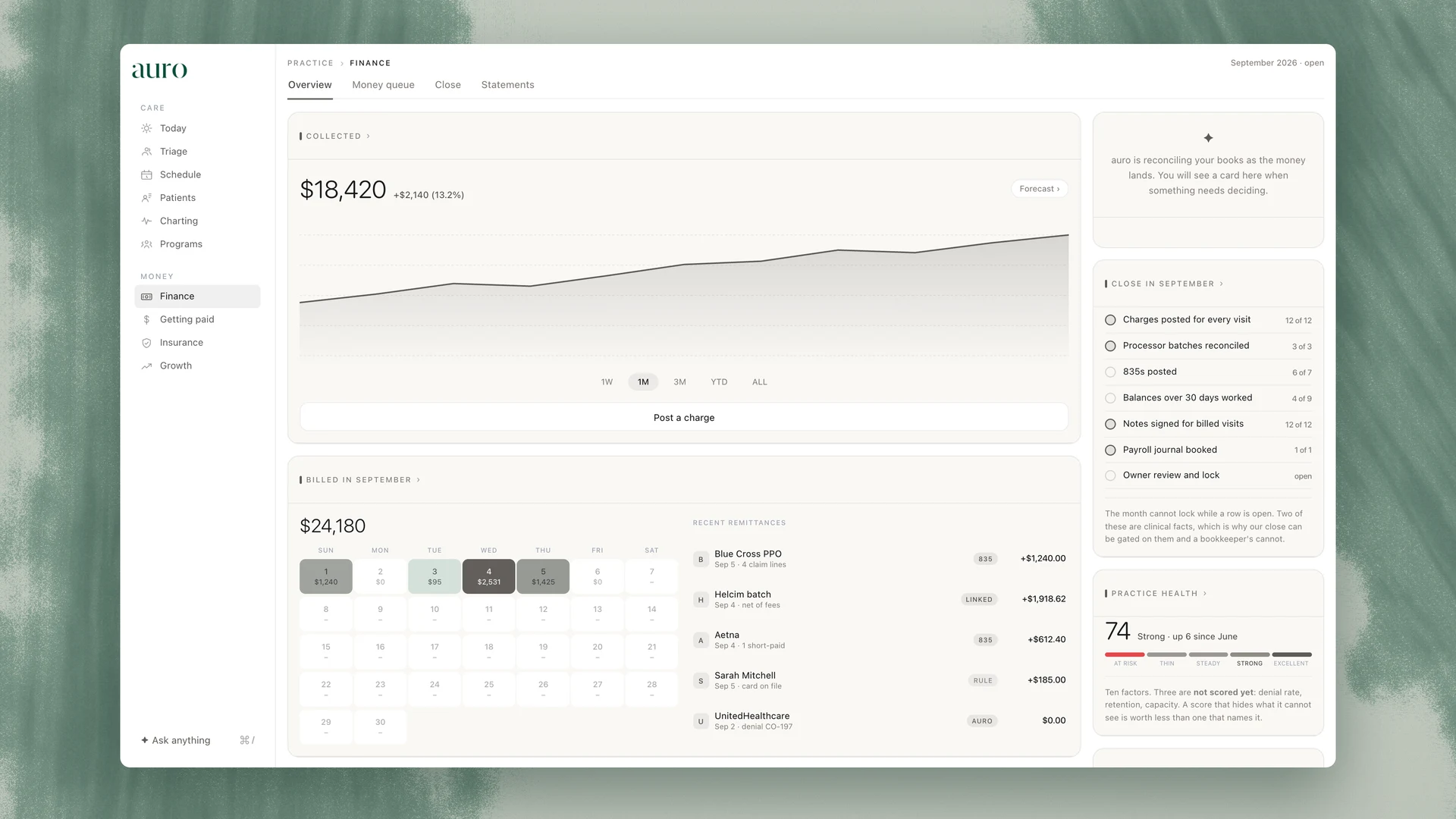
Every practice closes its month. Most close it in a spreadsheet, at night, at the end of a week that was already too long, by searching: for the visit that was never billed, the payment that was never posted, the note that was never signed. The search is the work, and the spreadsheet is where the search is written down afterwards.
A close on auro is 37 checks. The software runs all 37, and shows the owner only what failed.
Why a close is a set of questions
A spreadsheet is a shape for an answer. A close is not an answer; it is a set of questions, each with a yes or a no and a list behind it when the answer is no. "Does every billed visit have a signed note?" is a question. It has a definite answer, that answer can be computed, and when the answer is no the useful output is not a number but the three visits.
Once you write the month down as questions, two things follow. The first is that the close stops being a search and becomes a review: the software has already looked everywhere, so the person only reads the exceptions. The second is that the close becomes repeatable. Last month’s questions are this month’s questions, asked in the same order, by the same code, with no dependence on who was in the office.
What the checks actually ask
They fall into six families, and together they are the 37.
- The schedule and the notes. Every visit on the calendar has an outcome. Every visit that happened has a note. Every note behind a billed visit is signed by the clinician who saw the patient, not drafted and left. Every cancellation and no-show has a reason on it, because a no-show with no reason is a patient nobody followed up.
- Claims. Every billable visit produced a claim. Every claim has a remittance or an age. Every denial has a status and an owner. Every appeal has a deadline that has not passed. Nothing is sitting in a queue because the person who put it there left for the week.
- Money in. Every payment sits on a ledger line rather than in a deposit nobody has matched. Every patient balance is either collected, on a plan, or explained. Every refund has a reason and a signature. The processor’s settlement and the ledger agree, to the cent.
- The shelf. Every received box has an invoice. Every invoice matches an order and a packing slip three ways. The cost of goods lands against the period that consumed it, not the period that paid for it.
- People. Hours and sessions reconcile to what the schedule says happened. Anything paid to somebody has a record behind it.
- The record itself. Nothing is half-written. No visit is open. No draft is pretending to be a signed document. Nothing that was locked last month has moved since.
None of those is clever. That is the point. A close is not a place for cleverness; it is a place for completeness, and completeness is a list.
Thirty-seven, not a score
The number is 37 because that is how many questions it took to cover the month, not because 37 is a target. Nothing in auro grades the close, and there is no percentage at the top of the screen. A close is not a performance. It is either finished or it is not, and the only interesting information is the list of things that are not.
This is also why the checks are visible rather than implicit. A practice can read all 37, disagree with one, and ask us about it. A check nobody can inspect is not a control; it is a claim.
The exceptions are the product
What arrives in front of the owner is not a report. It is a short list, each item with the thing that failed, the record it failed on, and the action that would settle it. A visit missing a signature opens the note. A claim with no remittance and thirty days on it opens the claim with the verification and the reference number already attached, so the call to the payer starts from evidence instead of from memory.
When the list is empty, the month locks, and locked means locked: the numbers stop moving, and anything that would have changed them lands in the next period with a trail. A close that can be quietly edited afterwards is not a close.
An afternoon
The pilot practice reviewed and locked its September close in an afternoon. Twelve of its twelve billed visits had signed notes behind them. That is a small number, and it is the right size of number for a small practice: nobody needs a signing rate across ten thousand visits to know whether this month is clean. They need this month to be clean, and they need to find out on the second of the month rather than on the twenty-eighth.
The close is the moment a practice finds out whether its software has been telling the truth all month. We built it to be short on purpose, because the shorter it is, the more often it gets done, and a month that closes on time is a month whose mistakes are still young enough to fix.