

For the most sensitive records
Every default is the strict one. What the practice can prove to an auditor is what the software enforces, and nothing about a patient leaves the practice’s boundary.
Read the BAAWhat the practice can prove
Role-based access
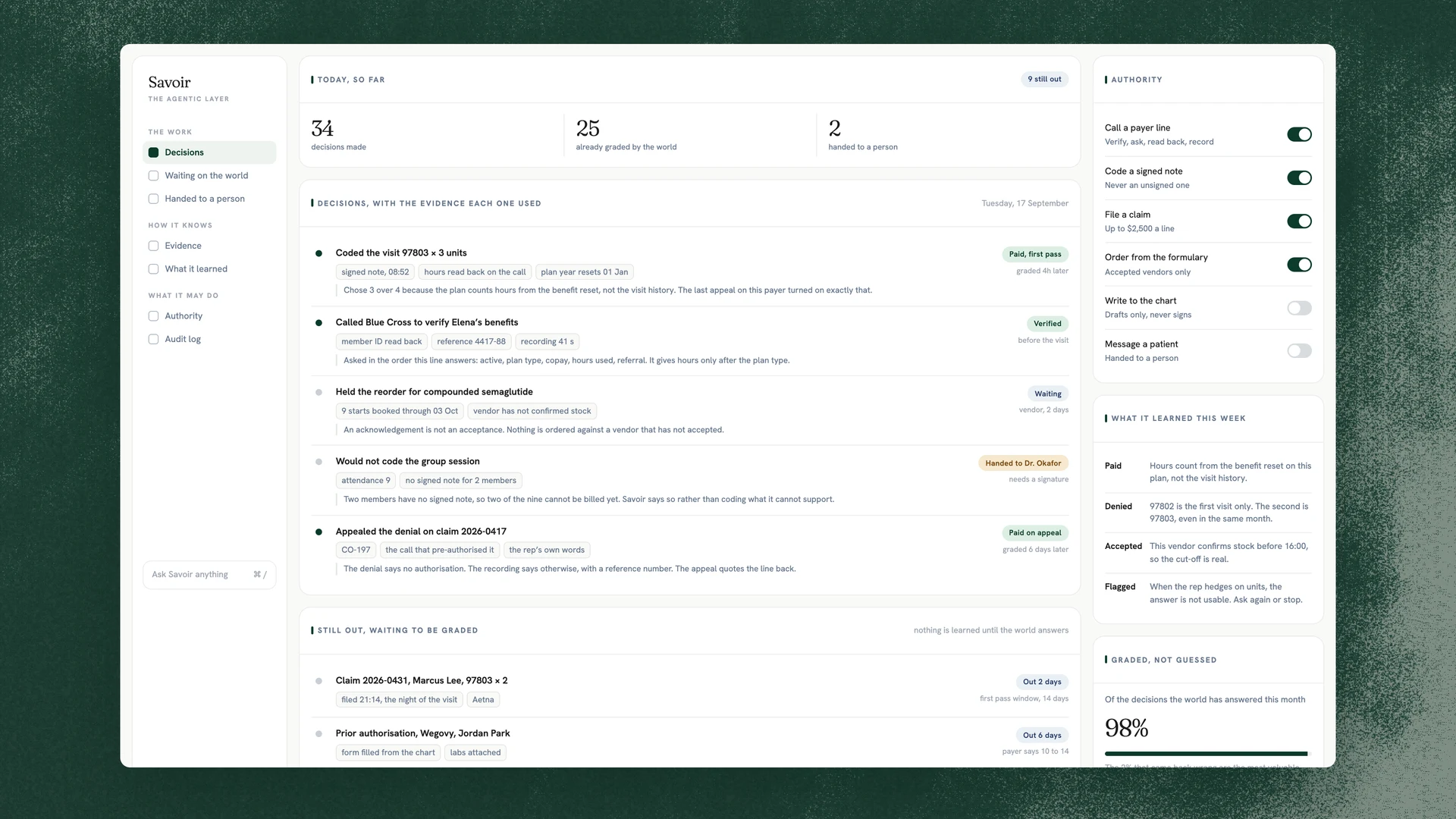
Every user is a role: owner, lead dietitian, clinician, coordinator, patient. The record shows each role only what its work needs, and the database enforces it, not the screen.
Consent-stamped recordings
A visit is recorded only after the patient consents, and the consent is stamped on the recording. Payer calls are recorded and kept for thirty days with their transcripts.
PHI stays inside the boundary
Nothing from a patient’s record is used to train a model, ours or anyone else’s. The model interprets the visit and the call; the practice holds the record.
MFA on every provider account
Multi-factor authentication for every provider sign-in. Sessions expire, and the audit log records who opened what and when.
Hosted in the United States
Data is hosted in the United States, encrypted with AES-256 at rest and TLS in transit, backed up in region, and purged on the practice’s retention schedule.
The BAA, signed at sign-up
The business associate agreement is signed when the practice signs up, before a single record exists. The sub-processors we rely on are listed on the terms page.
Built for the most sensitive records
Every default is the strict one. What the practice can prove to an auditor is what the software enforces: the BAA, the audit log, encryption at rest and in transit, retention and purge, and a boxed model that interprets but never holds the record.
Read the BAAHow it holds
The controls are not a policy document. They are the way the software is built: the role decides what a screen can show, the log records every read, the model is boxed, and the recording is the receipt. What follows is what a practice owner, or an auditor, asks us first.
Book a demoThe architecture behind the guarantees.
Everything above is a promise, and a promise is worth what the proof behind it is worth. Aureum is auro’s constantly auditing architecture. It re-checks every assertion the practice makes against what the practice can actually prove, continuously rather than when someone asks: the claim against the signed note it was coded from, the note against the visit that produced it, the code against the payer rule in force on the date of service, the benefit on a claim against the recording and the reference number behind it, the ledger against the bank. Every action auro takes carries a receipt saying what it saw, what it chose, under whose authority and what happened next, and where Aureum cannot prove something it flags it rather than asserting it.