

Savoir, taught by the work itself.
auro’s model for the back office of a metabolic private practice. Built on Kimi K3, open weights from Moonshot AI, and post-trained by auro on what a coder chose, what a biller appealed, and what a payer representative actually said on the line.
What happened
One example, from the claim to the label:
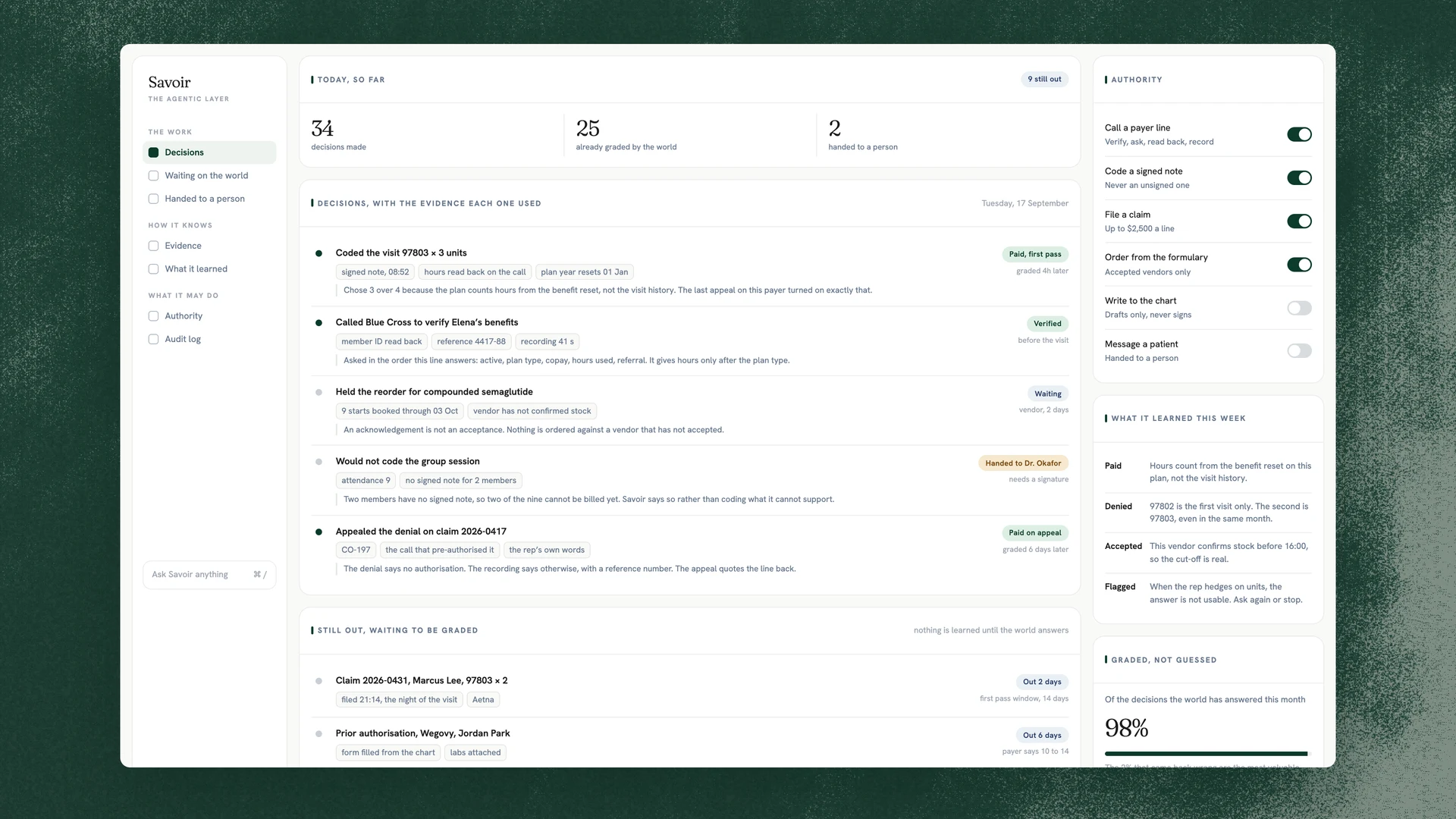
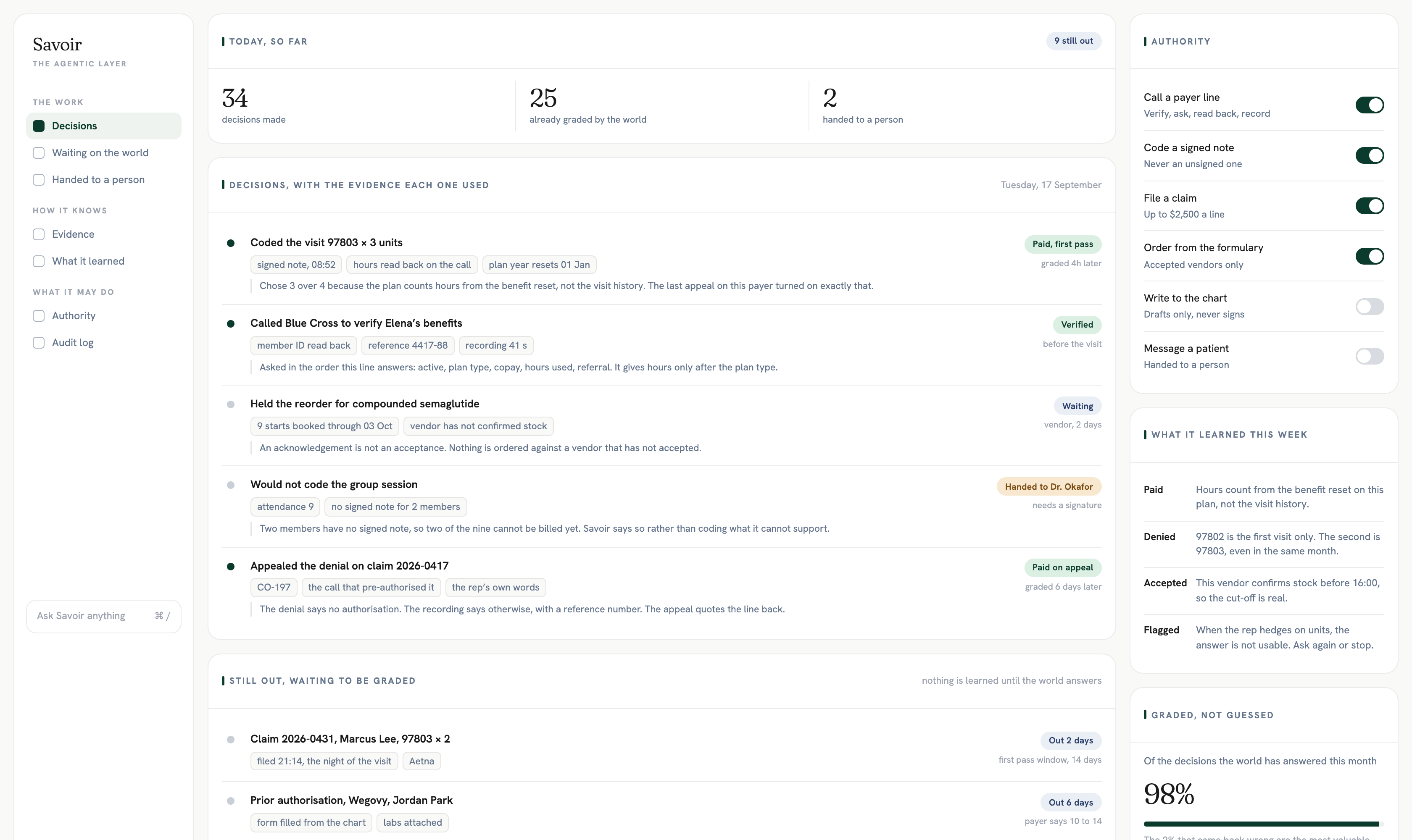
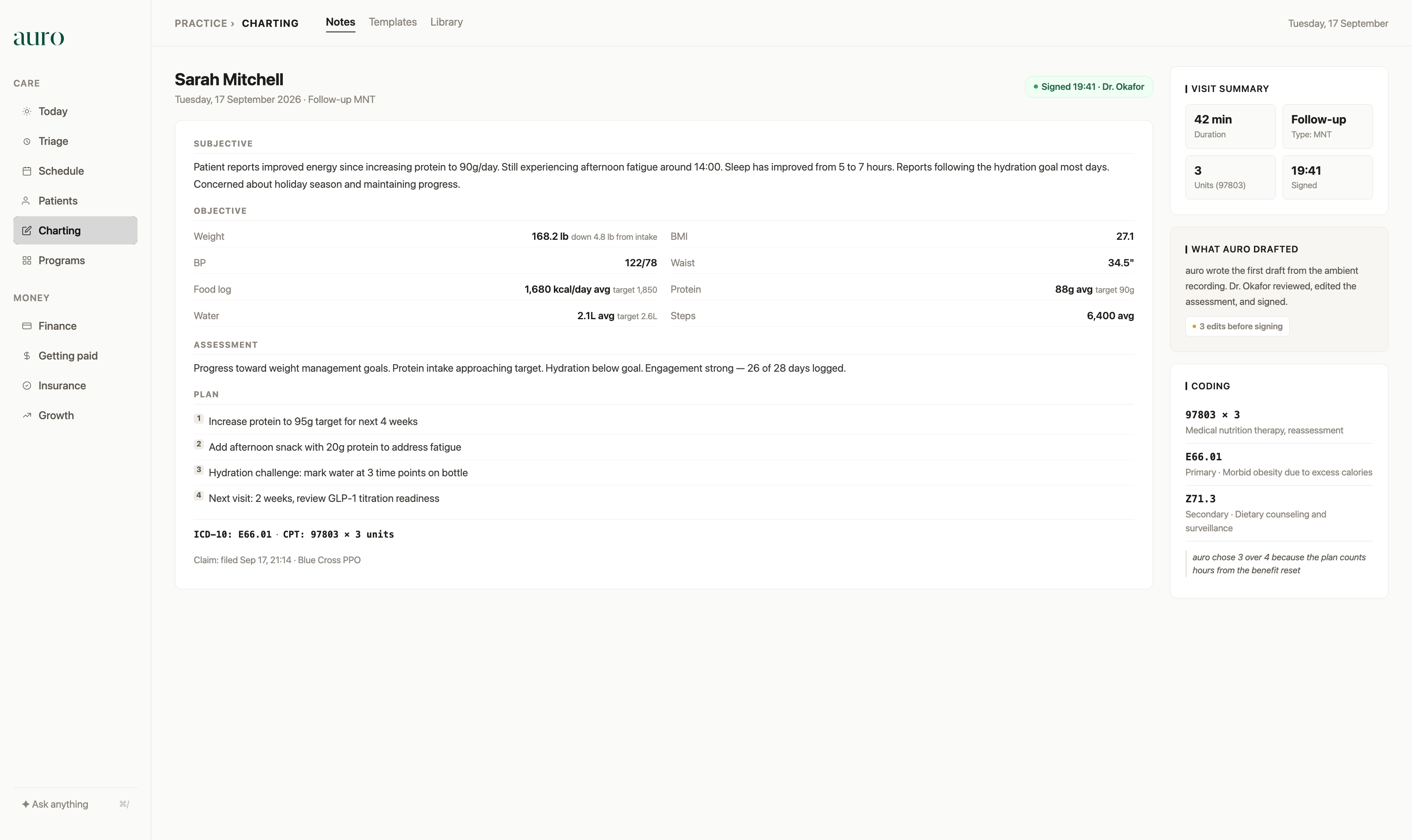
- The claim went out on 97803. Follow-up medical nutrition therapy, four units, filed the night of the visit against a note that had already been signed. The coder chose four units because the note recorded the time spent and the plan still had hours on it.
- It came back denied. The remittance said units exceed the plan maximum for the benefit year. The practice had counted the hours from the visit history. The plan counted them from the date the benefit reset, which is not the same date.
- The biller appealed with the payer’s own words. The verification call placed the night before the visit had the hours used read back by a representative, with a reference number and a recording behind it. The appeal quoted the call rather than arguing with the denial.
The label: what happened next
- Paid on appeal. The example is now a graded one: the first choice, the reason it failed, the correction that worked, and an outcome that says which was right. A model trained on the open internet has read about every part of this and has never once been told how it turned out.
A judgement problem, not a knowledge problem

A general model has read about the work. It has never sat in a practice at eight in the morning.
It knows what a CPT code is. It has not watched a coder choose between two of them with the visit note in one window and the plan’s hour rules in the other, and then find out three weeks later which one was right. The back office is not a knowledge problem. It is a judgement problem, and judgement is learned from the work, by doing it and being told.

So auro trains on the work.
The code a coder chose and the reason they gave for it. The appeal a biller wrote and the sentence that carried it. What a representative actually said on a recorded line, in their words rather than a summary of them. The note a dietitian signed. The order that was accepted and the one that came back short. Every one of them from a practice that agreed to it, under a business associate agreement, de-identified before it is used.

The outcome is the label.
auro sits on the whole loop: the call, the note, the claim, the remittance, the shelf. So it knows whether an answer was right, not merely whether it read well. That is the difference between an example and a graded example, and it is the rarest thing in this field. Most models are trained on text nobody ever marked. Savoir is trained on work that was.
Built on Kimi K3, open weights from Moonshot AI.
auro did not train a model from nothing, and does not pretend to. The base is an open-weight model anyone can download. What is auro’s is everything that happens after it: the post-training, on the work of a metabolic private practice back office, under a business associate agreement, on records that carry their own outcome.
- Base model
- Kimi K3, published by Moonshot AI in July 2026. Moonshot calls it open weight rather than open source, and so do we.
- Where the weights are
- Public, at huggingface.co/moonshotai/Kimi-K3, under the Kimi K3 License, which is Moonshot’s own text and not an MIT licence.
- Scale
- 2.8T parameters in total with 104B activated for any one token, in a mixture of experts. Moonshot’s figures, from the model card.
- Context
- 1,048,576 tokens, per the same model card. A year of one patient’s record fits in the window with room left over.
- What it was built for
- Moonshot describes K3 as natively multimodal and agentic, for long-horizon coding, knowledge work and reasoning. Agentic is the part that matters here: the back office is a sequence of tool calls, not a single answer.
- What auro adds
- Post-training on the back office itself, and the loop that grades it. That is the whole of Savoir, and it is the part no download gives you.
Every figure above is Moonshot AI’s own, from the Kimi K3 model card. auro publishes no benchmark score for Savoir. When there are results worth showing they will be a practice’s own numbers, measured on its own claims.
Everything the back office teaches
Why the loop closes here, and almost nowhere else.
Savoir is only possible because of how the practice it runs in is put together. A decision and its outcome have to sit in the same system before one can grade the other. In most of healthcare they do not.
In a hospital
The chart is one vendor. The revenue cycle is another.
- The clinician writes the note in the electronic health record.
- A coder in another department picks the code, in another system.
- The claim leaves through a clearinghouse nobody in the room can see.
- The remittance lands in a finance system the clinician never opens.
Four systems, four departments. The choice and the answer to it never meet, so nothing in that building can learn from the pair. More data, less signal.
In a private practice on auro
One operating system. The chart and the money are the same record.
- The visit is recorded and the note is drafted and signed.
- The code is chosen against that signed note, on the same record.
- Lana’s call, with the hours read back, is filed beside it.
- The claim, the denial, the appeal and the remittance are rows on the same row’s history.
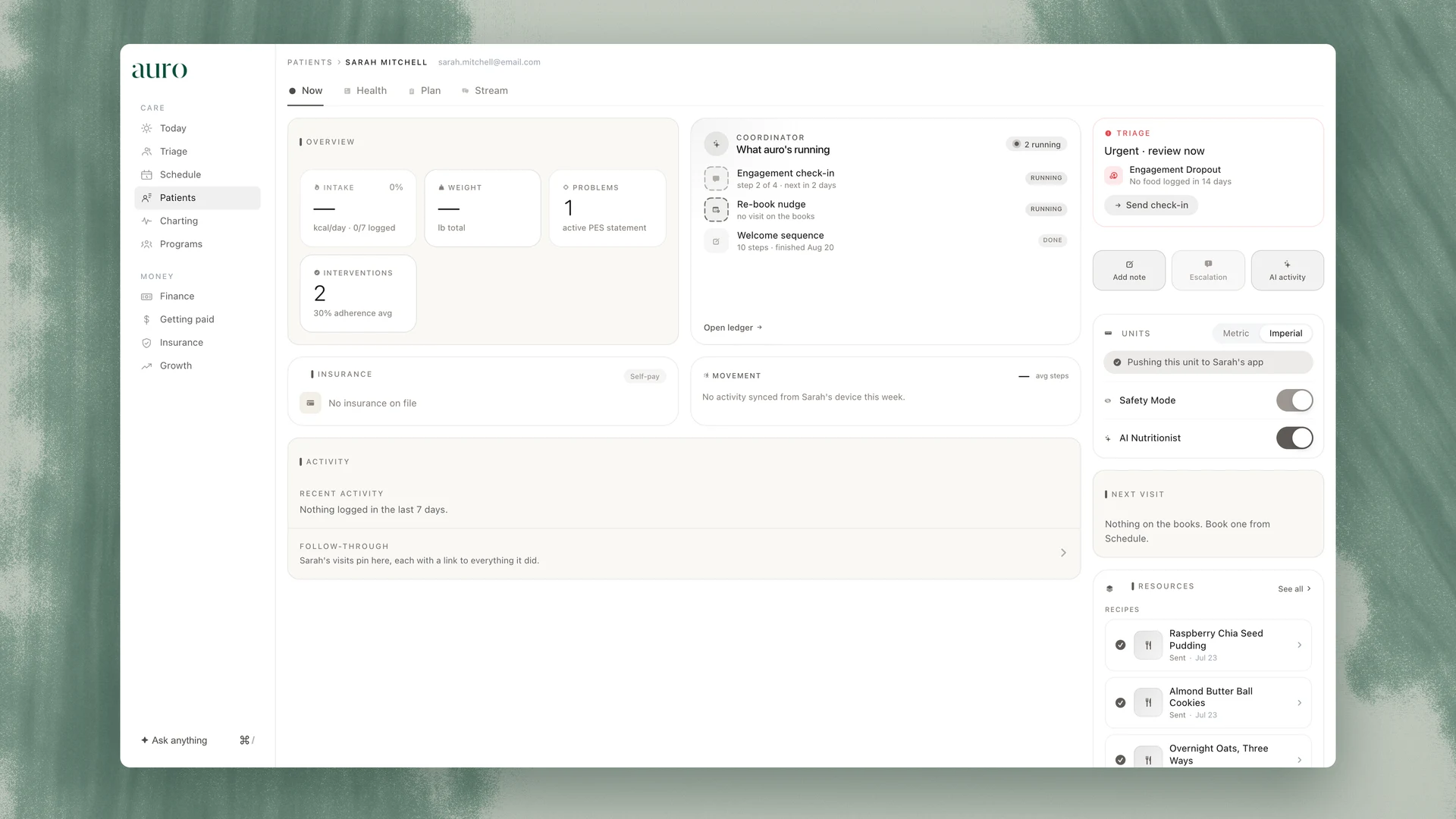
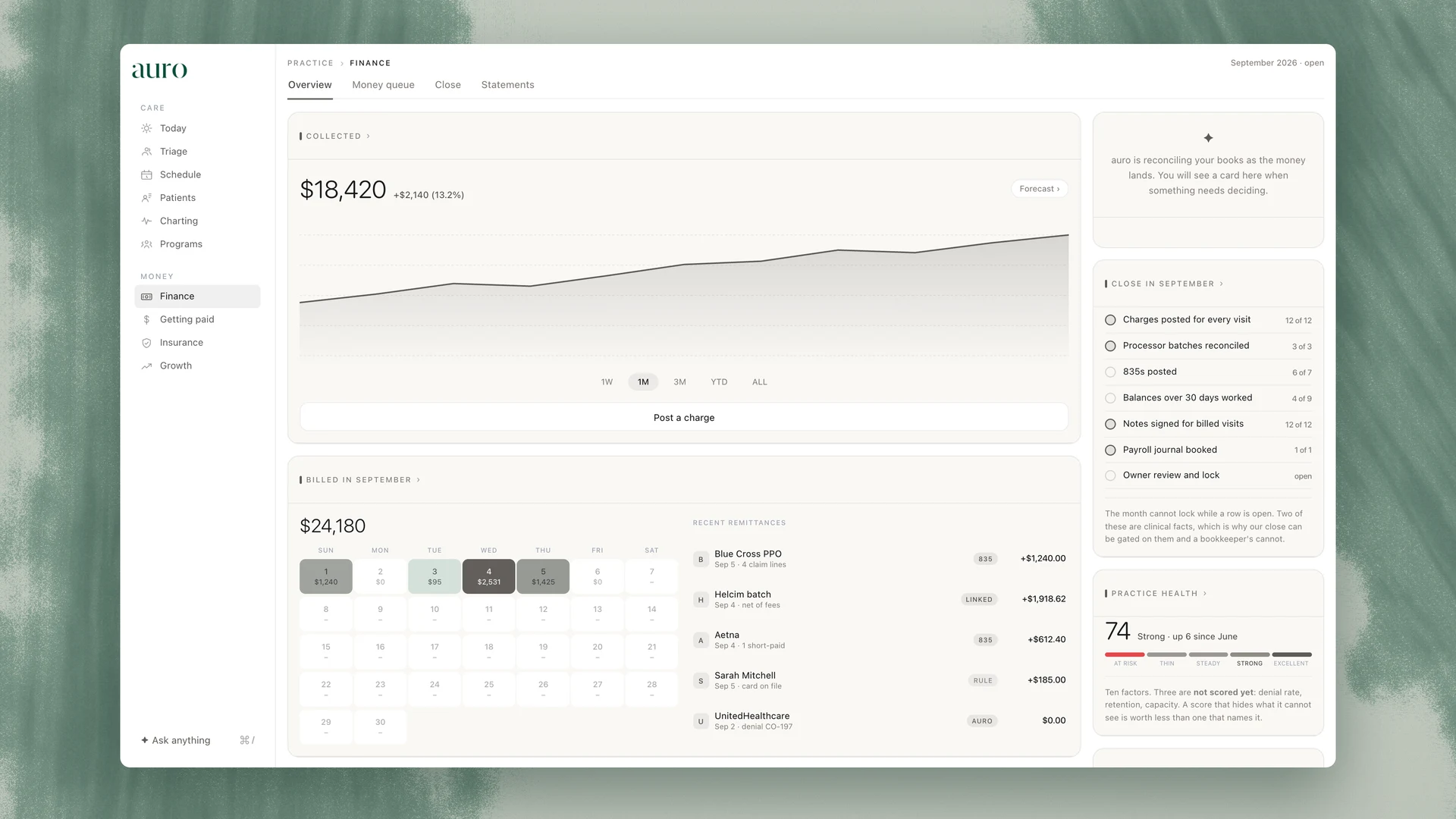
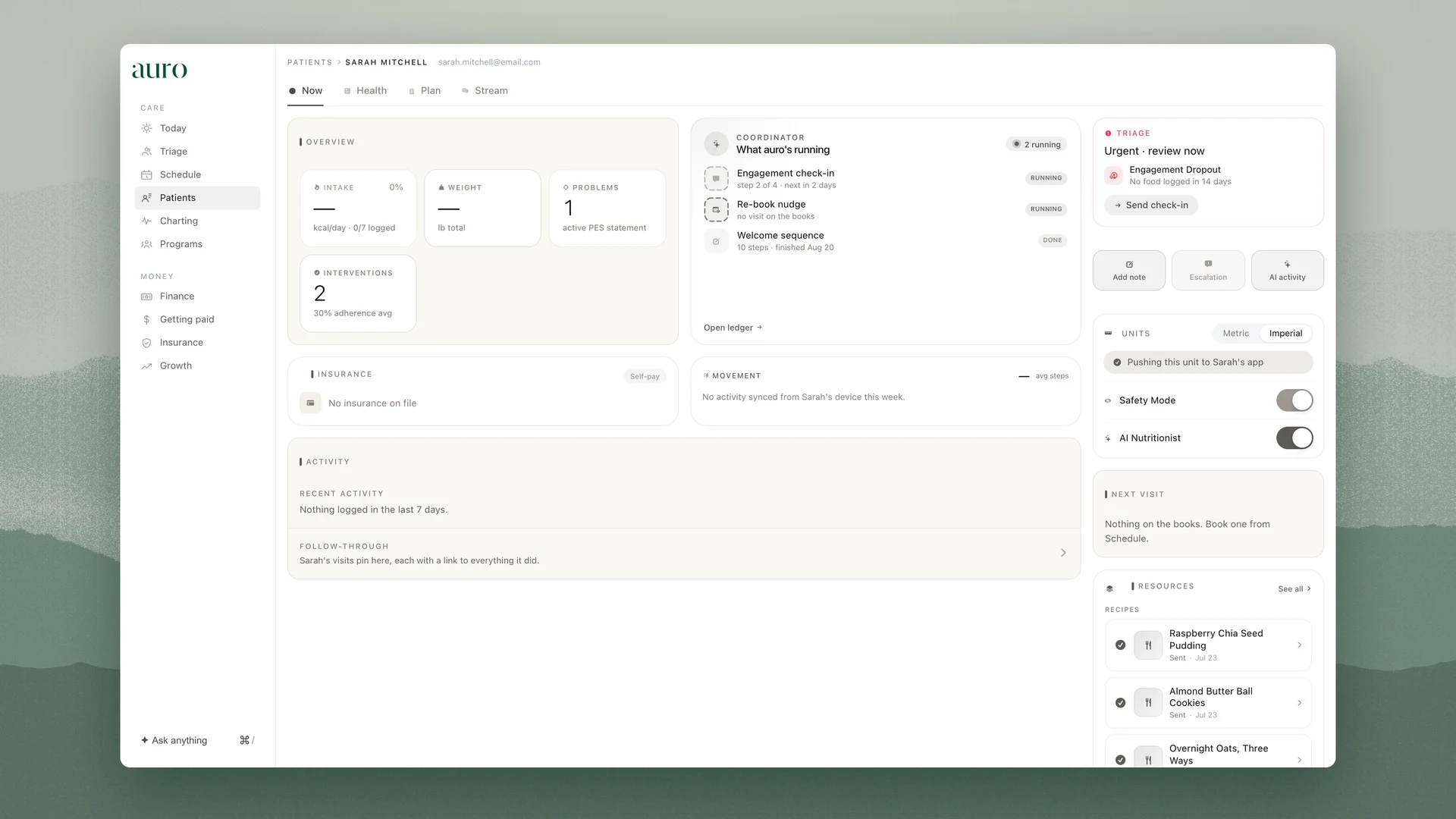
EHR, revenue cycle, supply and the patient’s day, in one system. The decision and its outcome are rows apart, not systems apart, which is the whole reason a grade exists at all.
This is why auro is a single operating system for a private practice rather than another tool bolted to one, and why the small practice is not the compromise in this story. It is the only place the loop closes.
The loop that labels the work.
A claim goes out. The payer answers. That answer is the grade, and a graded example is the only kind worth learning from. In the pilot, 98% of claims were paid on the first pass. The few that were not are the most valuable training data auro has.
The grade is produced by Aureum, auro’s constantly auditing architecture, which holds every claim against the note it was coded from and every benefit against the recording behind it, continuously, so a label is evidence rather than an opinion.
- A claim, coded from the note that was signed that afternoon.
- A call to the provider line, identifiers read back, questions in order.
- An appeal, written against a reason on a remittance.
- A reorder, placed against what was actually dispensed.
What a person in the practice decided, and the reason they gave for deciding it.
- Paid on the first pass.
- Denied: units exceed the plan maximum for the benefit year.
- The representative’s own words, with a reference number behind them.
- The order accepted, or short shipped and received short.
Not a review, not an opinion. An outcome, with a date on it.
- The choice that was paid becomes an example of the right call.
- The choice that was denied carries the reason it failed.
- The appeal that worked is the correction, attached to the mistake.
A claim is not training data until it is paid or denied. This is the part the internet does not have.
Where the loop is already turning
The guardrails are the design, not a disclaimer under it
More about trustTrained under a business associate agreement
Savoir learns only from records covered by the BAA the practice signed, and only from practices that agreed to it. No agreement, no training. There is no scraped corner of this.
De-identified at the boundary
Name, date of birth and contact are stripped before a record is used. The clinical facts cross the membrane; the person does not. The same sanitizer that guards the live model guards the training set.
Your data trains your behaviour
What a practice teaches Savoir shapes how Savoir works for that practice: its payers, its codes, the way its notes read. It is never used for someone else’s practice without consent in writing.
It interprets. It never holds the record.
The record stays in the database under the practice’s control. The model is handed what it needs, returns a suggestion, and keeps nothing. A boxed model, by design, as everything here is.
Unsure means flagged, not guessed
The same law Lana works under on the phone. When the evidence does not support an answer, Savoir says so and sends it to a person, with what it saw. Zero invented answers.
Attributable and revertable
Every action Savoir takes is written to the audit log with the evidence it acted on, attached to a person or to itself. Every one of them can be put back.
Knowing how, not knowing about
Savoir faire is knowing how to do the thing. Savoir on its own is only knowing about it. The model is named for the gap between the two, and it closes that gap one practice at a time.
For dietitian practices
The payers on your wall, the codes that get paid there, the note templates your clinicians actually sign. Savoir learns the practice it works in, and stays inside it.
Explore dietitian practicesFor GLP-1 clinics
Coverage verified before the visit, the visit coded the way that plan pays, the refill reordered against what was actually dispensed. One loop, one record, one model watching all of it.
Explore GLP-1 clinics“Savoir flagged a coding pattern I didn’t know I had. I was under-billing every GLP-1 follow-up.”

“It reads my notes and tells me what I missed. Not in a pop-up — in the triage queue, before the next visit.”
“The model explains why it chose three units over four. I trust it because I can see the reasoning.”
“Savoir learns from the work. After a hundred signed notes, it stopped suggesting things I always delete.”