

What the shelf knows
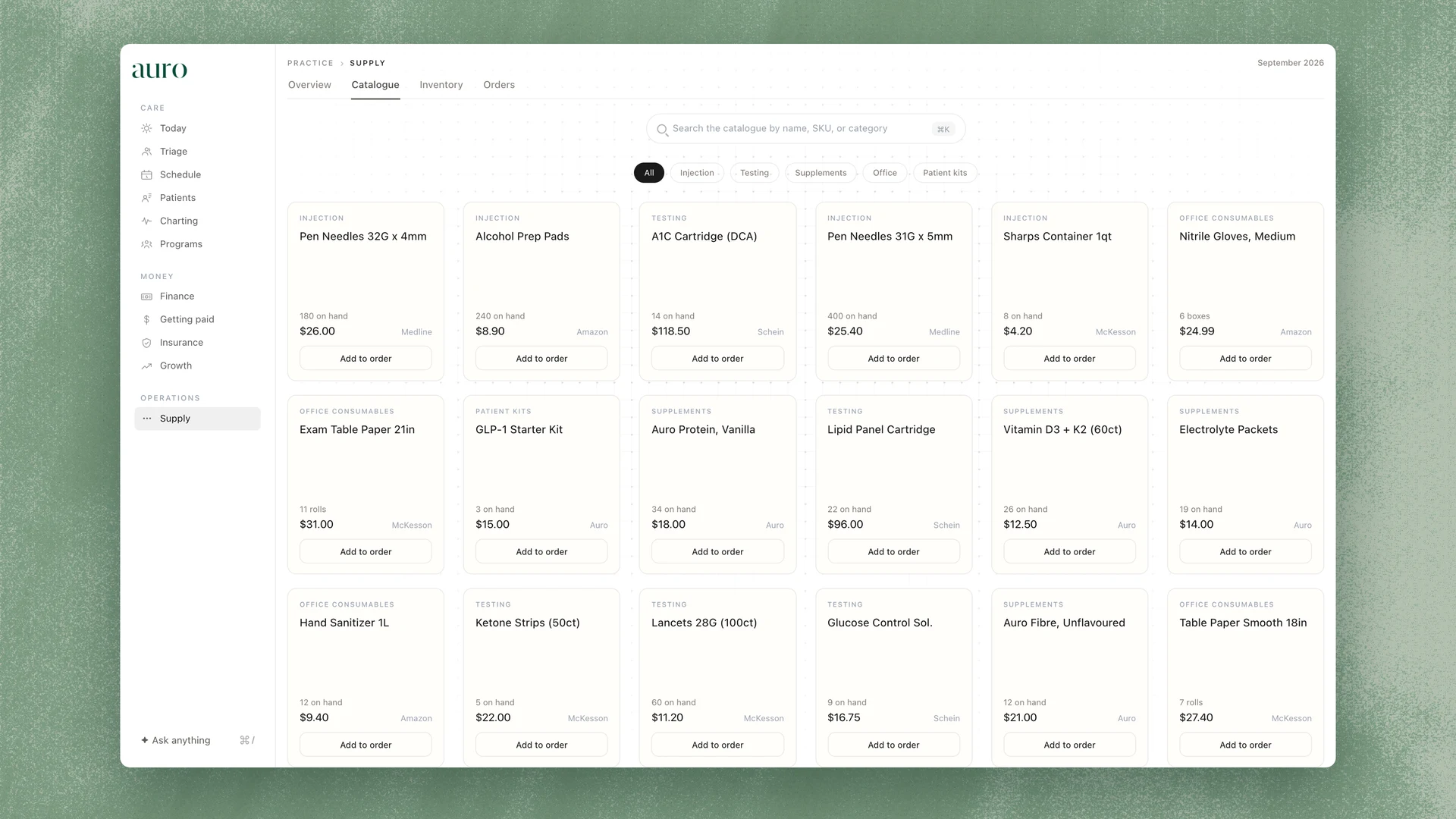
Ask a practice owner how the apothecary is ordered and the honest answer is usually a person: somebody notices a gap, somebody orders, the box arrives late, and a visit moves. Ordering is driven by whoever last opened the cupboard. It is not a system. It is a habit with a purchase order attached.
Most inventory software answers this with the tools of a warehouse: a reorder point, a six-month average, a minimum on hand. Those tools assume demand is a weather pattern you observe from outside. In a clinical practice that assumption is simply wrong, and it is wrong in a way that is worth being precise about.
The practice already knows what it is going to use
A warehouse does not know who is walking through the door next Tuesday. A practice does. The booked week is not a forecast; it is a list of names with appointment types attached, and an appointment type is a good predictor of what comes off the shelf. A titration visit draws differently from an initial assessment, a lab day differently from a follow-up, and a group session draws almost nothing and then everything at once.
So the schedule predicts the draw. Not as a statistical inference over the past, but as a reading of the near future that the practice itself wrote down. This is the whole idea behind auro Supply, and it is only available to software that can see the calendar and the stockroom at the same time. That is why supply ordering belongs inside the chart rather than beside it.
What goes wrong when the shelf lives somewhere else
When ordering is a separate system, three failures follow, and every practice we have talked to has had all three.
- The reorder point lags the calendar. An average over the last six months is a description of a season that has finished. It cannot know that the practice took on a new program in April, or that a prescriber down the road started referring in June, until the shelf has already run out once.
- The cost lands in the wrong month. Stock bought in one period and consumed in the next shows up as a bad month followed by a flattering one. The practice does not learn what a visit costs to deliver; it learns what the invoices happened to do.
- Nobody reconciles the box. The order says twelve, the packing slip says ten, the invoice says twelve, and the difference is found in the following quarter by an accountant, or not at all.
Reading the week
Auro reads the booked week and works out the expected draw, item by item, from the appointment types on the calendar and what visits of that type have actually consumed in this practice. The reorder point moves with the calendar rather than with the average. When the expected draw would take an item below the point before the next delivery could arrive, a purchase order is drafted, at the supplier and the price the practice last bought at, with the price watch showing whether that price has moved.
Drafted, not sent. The order waits for a person, because ordering is a spending decision and spending decisions belong to the practice. What the software has removed is not the decision; it is the noticing. Nobody has to open the cupboard to find out.
The three-way match
When the box arrives, the order, the packing slip and the invoice are matched three ways on the same record. If the three agree, the cost lands on the ledger against the period that will consume the stock. If they disagree, that is an exception with a name on it, and it appears in the monthly close rather than in a filing cabinet.
This is the point at which supply stops being logistics and becomes money. The cost of goods is not a line somebody types in at the end of a quarter; it is the arithmetic consequence of boxes that arrived, matched to visits that happened. A practice that has that can answer the question every cash-pay practice eventually asks, which is what a given program actually costs to deliver.
What we are not claiming yet
We have not published a figure for how well the booked week predicts the shelf, and we are not going to until there is more than one season of record behind it. A single quarter of one practice is an anecdote wearing a percentage sign. The question is on our research page as a question, and it will stay a question until the record can answer it.
What the pilot practice will say is narrower and more useful: it stopped moving appointments because of a late box. That is not a statistic. It is the thing the statistic would eventually be about.
Why it belongs in the chart
The shelf knows the calendar, the calendar knows the patients, the patients have plans, and the plans are what the shelf is for. Every one of those connections is an edge in the same graph, and the moment you cut the graph in two you need a person to carry information across the cut. That person is the practice owner at nine at night with a clipboard.
Keeping supply inside the record is not an integration and not a convenience. It is the reason the software can see the draw coming at all.